
The Shift: From Predicting to Executing
In 2026, enterprise AI crossed a line. Systems no longer just recommend — they act. Agentic AI executes payments, settles invoices, books appointments, files documents, and modifies workflows autonomously.
Gartner places agentic AI at the center of its 2026 outlook, and IDC projects more than one billion deployed AI agents by 2029. The productivity case is obvious. The governance case is not.
When an agent only recommends, a human filters every output before it becomes real. When an agent executes, a wrong decision is already reality before anyone reviews it. This single shift rewrites how oversight, accountability, and evidence must work.
The Governance Gap
The 2026 consensus across analysts and practitioners is that autonomous systems have created a governance gap: agents can now independently execute financial transactions or change operational state, but most organizations still govern them with controls designed for a world where humans did everything.
Closing the gap means answering three questions for every agent:
| Question | Control |
|---|---|
| What can this agent do — and not do? | Permission boundaries (enforced, not documented) |
| Which decisions require a human? | Oversight checkpoints |
| When a decision is challenged later, what is the evidence? | Proof layer |
Most governance conversations cover the first two. The third — proof — is where almost everyone is underbuilt.
Human-on-the-Loop Is the Right Answer — But Incomplete
The dominant 2026 pattern is human-on-the-loop (HOTL): let agents run autonomously, but insert human oversight at the highest-risk points rather than at every step.
The industry is converging on where those points are. Human oversight matters most at:
approvals · exceptions · irreversible actions · and decisions with legal, financial, or employment consequences.
This is also where regulation points. The EU AI Act requires effective human oversight for high-risk AI systems (Article 14) and automatic logging (Article 12), with enforcement intensifying from August 2, 2026. South Korea's AI Basic Act (effective January 22, 2026) similarly requires impact assessment and user-protection measures for high-impact AI.
So HOTL is correct. But here is the gap most teams miss: inserting a human is not the same as proving the human did anything meaningful.
Why "A Human Approved It" Is Not Evidence
Consider what regulators and auditors actually ask versus what most systems can produce:
| What an auditor asks | What most platforms have |
|---|---|
| "Prove a qualified human reviewed this specific decision." | "A log shows someone clicked Approve." |
| "What data did the agent use to decide?" | "We can show inputs in aggregate." |
| "Show this record was not altered afterward." | "Our database has access controls." |
| "Produce the evidence for this one decision on this date." | "We can generate a report." |
A click-level approval event is trivially weak. It does not show how long the reviewer looked, what they changed, why they overrode the agent, or whether the record was modified after the fact. In a dispute — a wrongful denial, an incorrect payment, a contested settlement — that thin record collapses.
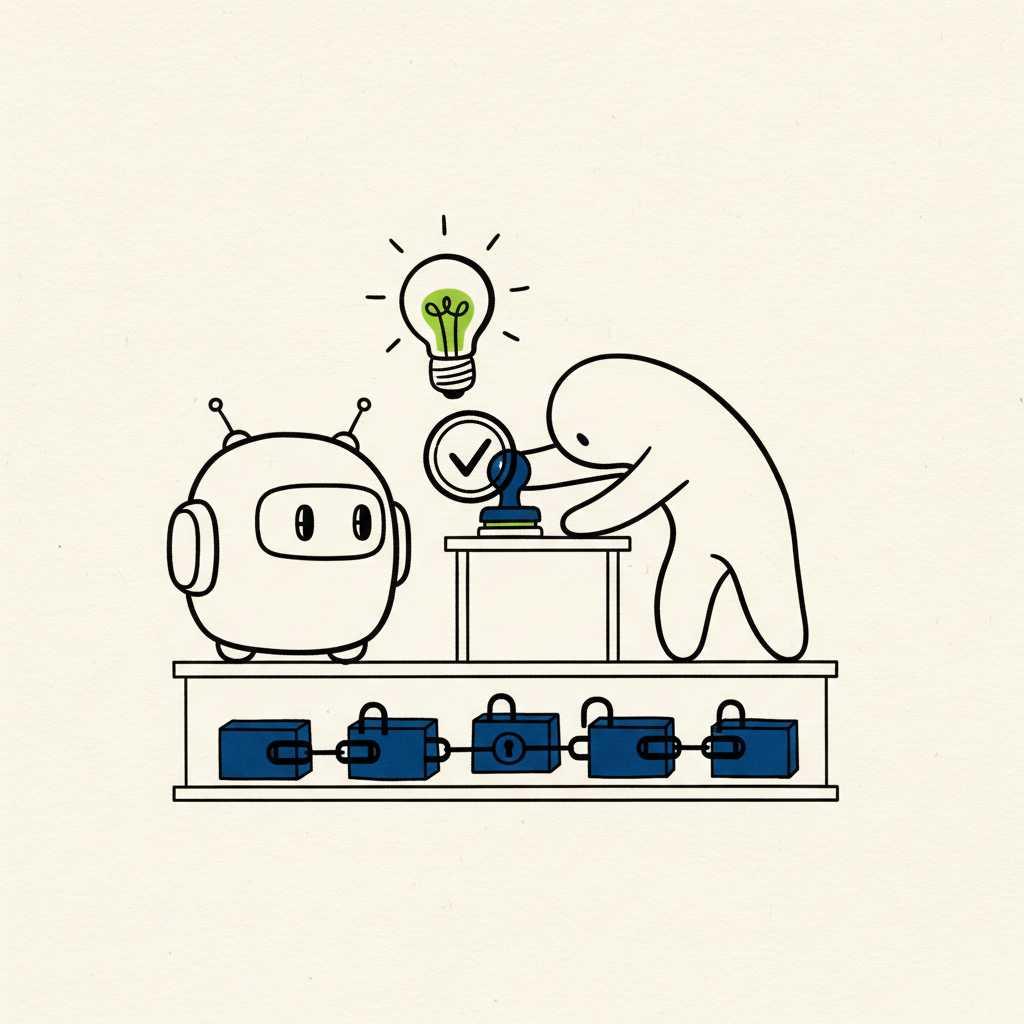
This is why human-on-the-loop needs a proof layer: an immutable record that captures not just the agent's decision and the human's involvement, but the quality of that involvement, bound together so it cannot be altered.
What a Proof Layer Must Capture
A credible proof layer for agentic AI records four linked elements as a single decision unit:
1. What the agent decided      → inputs, model, rationale, confidence
2. What the human reviewed     → reviewer identity + role, duration,
                                  modifications, override reason
3. What was actually executed  → the real-world action taken
4. Cryptographic binding       → hash chain so 1–3 cannot be altered
Three properties separate a proof layer from ordinary logging:
- Immutability — entries cannot be silently changed after the event. A hash chain makes tampering detectable.
- Continuity — because agents decide constantly, evidence must be generated continuously and automatically. Point-in-time audits are no longer sufficient; real-time capture is replacing periodic review.
- On-demand extraction — any single decision must be retrievable in a standard format the moment an auditor or regulator asks.
A fourth, increasingly standard practice: treat agents as identities. Every agent should be registered, scoped to explicit permissions, and have its actions attributed the same way a human user's are — so "which agent did what, under whose authority" is always answerable.
Build It as a Byproduct, Not a Project
The failure mode is predictable: teams treat governance as a separate workstream — a policy document, a quarterly review, a manual evidence-gathering exercise. The moment proof depends on someone remembering to document, it stops happening under load.
The durable approach is the opposite. Proof should be a byproduct of the operational workflow itself. When the act of approving, executing, or overriding an agent decision automatically writes an immutable record, governance adoption friction drops to near zero — and the evidence is complete precisely because no one had to choose to create it.
How Cronozen Approaches This
Cronozen is built around a single thesis: infrastructure for keeping AI decisions under human control and provable. The agentic governance pattern above maps directly onto the product.
- Operational oversight surface — high-stakes decisions (settlement confirmation, voucher claims, document submission) route to an in-app review screen where the responsible person can approve, modify, or reject — embedded in the daily workflow, not bolted on.
- Decision Proof Unit (DPU) — the agent's decision, the human review, and the executed action are bound into one unit and written to a SHA-256 hash chain. The "who, when, what, why" becomes tamper-evident.
- Review quality, not just events — DPU captures review duration, modifications, and rejection reasoning, plus the reviewer's qualification — exceeding both "meaningful review" and "effective oversight (Art. 14)" standards.
- One-click evidence export — any single decision can be extracted in a standard format for an audit or complaint.
DPU is a Layer 3 control: it does not replace model monitoring or policy management. It supplies the operational proof those layers claim to manage but rarely capture.
The Takeaway
Agentic AI is a genuine leap in capability. But execution carries a different class of risk than recommendation — wrong decisions become real instantly, and "a human approved it" is not a defensible record.
Human-on-the-loop is the right control. A proof layer is what makes it accountable. Together they answer the only question that matters when an agent's decision is challenged:
Can you prove what your AI decided, who reviewed it, and that the record was never altered?
References
- Gartner, "Hype Cycle for Agentic AI" (2026)
- IDC, deployed AI agents forecast (2026)
- EU AI Act — Article 14 (human oversight), Article 12 (automatic logging); enforcement from August 2, 2026
- South Korea AI Basic Act, effective January 22, 2026
- Industry analysis on agentic governance: human-on-the-loop shift, immutable audit trails, agents as identities, real-time vs. periodic monitoring (2026)
Related reading — "AI Audit Trail vs Decision Proof Unit: Why Logging Isn't Enough," "Best AI Governance Platforms 2026: Where DPU Fits in the Stack," and "What is DPU?" in the Cronozen AI Compliance category.